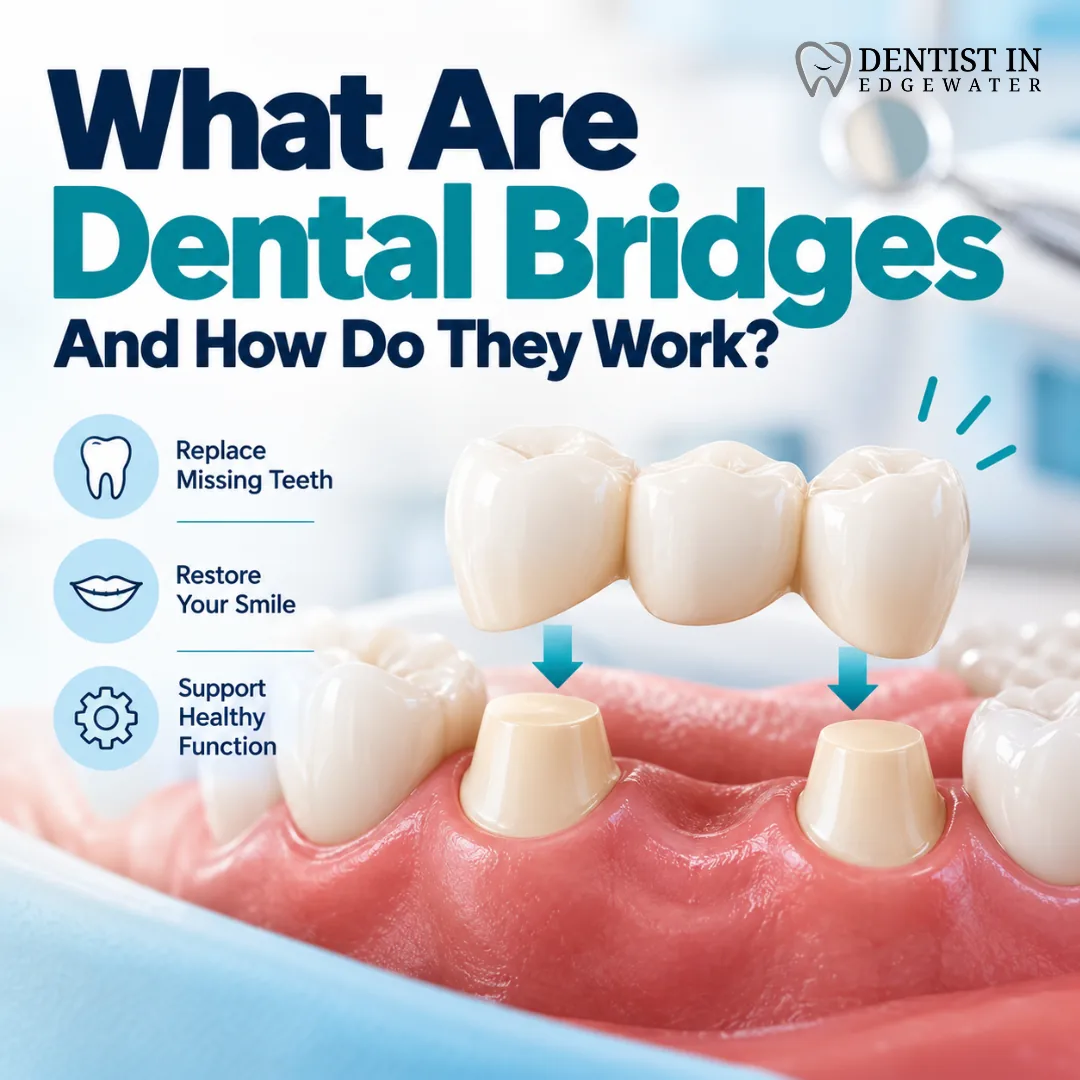
Losing a tooth can feel awkward. Eating feels harder. Talking can change. Many people want a steady fix that looks normal.
Dental Bridges replace missing teeth by filling the gap with an artificial tooth. They attach to nearby teeth or implants for support. This piece will explain what Dental Bridges are, how they work, and the common types.
A dental bridge is a prosthetic replacement that fills a gap left by one or more missing teeth. It uses nearby teeth as anchors, called abutments, to support the artificial tooth, or pontic.
Dentists place crowns on the adjacent teeth to hold the pontic, and the procedure needs at least two anchor crowns to secure the restoration. The most common form, the traditional bridge, uses crowns on both sides, but bridges can also attach to dental implants or be removable.
Bridges restore chewing function and protect remaining teeth from shifting into the gap. A dentist recalls fitting a traditional bridge that used two abutment crowns to replace three teeth, and the patient regained normal chewing within days.
This restoration offers a simple, noninvasive tooth replacement that helps keep the smile and oral health intact.
Nearby teeth serve as anchors, called abutments, to hold the bridge in place. Dentists place crowns on those abutment teeth. A pontic, the prosthetic tooth, sits in the gap. Most traditional bridges use two crowns to secure the pontics.
The procedure involves shaping healthy adjacent teeth and fitting crowns, then attaching the pontic. Some bridges use dental implants as support instead of crowned abutments. Bridges literally bridge the gap to restore smile appearance and tooth structure.
Bridges restore chewing function that patients lose after tooth loss. They also stop remaining teeth from shifting into open spaces. Patients get either a permanent restoration or a removable replacement, based on the type chosen.
Crowns and pontics make the prosthetic strong enough for daily chewing. Dentists discuss dental implants when a more stable abutment is needed. This treatment keeps oral health and helps maintain facial support.
Dental bridges come in several types, each serving a different purpose. Traditional bridges use crowns on adjacent teeth to support the replacement tooth. Cantilever bridges attach only on one side for stability.
Maryland bonded bridges connect to surrounding teeth with metal or porcelain wings. Implant-supported bridges rely on dental implants for strong foundation support.
Traditional bridges remain the most common type of bridge. They replace one or more missing teeth by filling the gap with a pontic. The pontic anchors to crowns placed on adjacent abutment teeth. The procedure requires at least two anchor crowns on healthy teeth to hold the prosthetic firmly.
A prosthodontist recalled fitting a traditional bridge for a patient who lost a molar, preparing the abutment teeth and placing crowns over two visits. Patients regain chewing function and a natural smile after this restoration, and the bridge helps stop nearby teeth from shifting out of position.
Cantilever bridges offer a unique method for tooth replacement. They consist of one or more prosthetic teeth, known as pontics, supported by a crown on just one side. This type of bridge works well in situations where there is only one healthy adjacent tooth available to act as an anchor.
Many patients prefer cantilever bridges because they can be less invasive and quicker to install compared to other types.
In practice, the dentist places a crown on the existing abutment tooth. Then they attach the pontic to that crown, effectively bridging the gap left by missing teeth. Cantilever bridges serve an important role in restoring functionality and maintaining oral health.
They help prevent remaining teeth from shifting out of position while providing a smile restoration that many seek after losing teeth.
Maryland bonded bridges offer a unique way to replace missing teeth. These bridges do not require crowns on adjacent teeth. Instead, they use a metal or porcelain framework that bonds to the back of existing teeth for support. This design holds the artificial tooth securely in place while keeping dental structure intact.
Patients often prefer Maryland bonded bridges for their noninvasive nature and ease of placement. The procedure is swift and doesn’t involve altering healthy adjacent teeth significantly.
They work well for front teeth restoration, helping individuals regain their confident smile without extensive dental work.
Implant-supported bridges attach to dental implants for added stability. These implants serve as strong anchors in the jawbone. They hold one or more pontics, filling the gap left by missing teeth. Unlike traditional bridges, these do not rely on nearby teeth for support; instead, they provide a sturdy base.
During the procedure, dentists place titanium posts into the jawbone. Over time, these posts fuse with the bone in a process called osseointegration. This ensures that the bridge stays secure and functional for years.
Patients often find that implant-supported bridges improve their chewing function and overall oral health. They help prevent remaining natural teeth from shifting out of position too.
Many people appreciate this noninvasive option because it offers a natural feel and appearance similar to real teeth.
Dental bridges offer a way to restore missing teeth effectively. They improve chewing function and help maintain facial structure, making smiles more complete.
Dental bridges restore the ability to chew effectively. They fill gaps left by missing teeth and help maintain normal bite patterns. This restoration relies on nearby healthy teeth as anchors.
By supporting artificial teeth, dental bridges provide a solid foundation for everyday functions like eating.
Patients often report feeling more confident after receiving dental bridges. They notice improved chewing function, allowing them to enjoy a variety of foods again. Protecting adjacent natural teeth from shifting into empty spaces also contributes to better oral health over time.
Overall, these prosthetics significantly enhance daily life for many individuals dealing with tooth loss.
Restoring functionality plays a crucial role in oral health. Maintaining facial structure is another important benefit of dental bridges. They prevent the remaining natural teeth from shifting into gaps created by missing teeth.
This shifting can lead to misalignment and further tooth loss. By filling these gaps with prosthetic replacements, dental bridges help keep everything in its rightful place.
The artificial teeth, or pontics, offer more than just aesthetics; they provide support to the jawbone too. Without proper support, the bone may weaken over time due to lack of stimulation.
Therefore, patients who choose dental bridges enhance their smiles while also protecting their facial features from sagging or changing shape as they age.
Caring for dental bridges is essential for maintaining oral health. Proper care ensures they last and function effectively.
A dental bridge is a fixed dental appliance. It replaces one or more missing teeth by anchoring to the surrounding teeth. This helps restore your smile and improve chewing.
Dental bridges work by using crowns on adjacent teeth as supports. The false tooth, called a pontic, fills the gap left by missing teeth. This creates a stable structure that looks and functions like natural teeth.
People who have lost one or more teeth may need a dental bridge. If you struggle with chewing or feel self-conscious about gaps in your smile, this option can be helpful.
Yes, there are several types of dental bridges: traditional, cantilever, and Maryland bonded bridges. Each type has its own method of attachment based on individual needs and circumstances.
Tell us a little about what you need — we'll be in touch shortly.
15 Lee Airpark Dr #100, Edgewater, MD 21037,United States
Hi! I'm Tooth fairy! Your AI Assistant Ask me anything